
NO OUTLET
home, belonging, and a cul-de-sac

Where are you from?
How do you even begin to answer that question when you meet someone for the first time? Your place of birth, where you were raised, the city where you first moved out on your own? I usually dribble it all out, then return the favor, How 'bout you?
If time tells, I suppose I call this mountain suburb home. It’s the longest I’ve stayed anywhere—long enough to form some habits. Every morning, I sit on my porch—barely wide enough for a chair, my feet edging the bricks, feeling for balance—as I drink coffee, meditate, and read. These days I’m reading Landmarks by Robert Macfarlane.
To know fully even one field or one land is a lifetime’s experience.
I want to believe him, but how can I choose? I’d have to start by identifying all the fields, studying their qualities, deciding which would best suit my needs—what makes for a good field, anyway? I could spend a lifetime just looking for a field.
The view from my porch is mostly trees that I’ve neglected to limb in an effort to avoid direct visual contact with my neighbors. I’ve left it that way so my mind can wander without distraction. But there’s one thing those trees can’t cover—something that grounds my wandering thoughts each morning—a bright yellow sign, NO OUTLET. Its bold letters scream at me, bordered in a stark yellow, marking the cul-de-sac just beyond, as if to repeat itself in case I missed it.
NO OUTLET
That one phrase somehow carries both my deepest longings and my deepest fears—to find the place where I belong, and to let go of every other place.
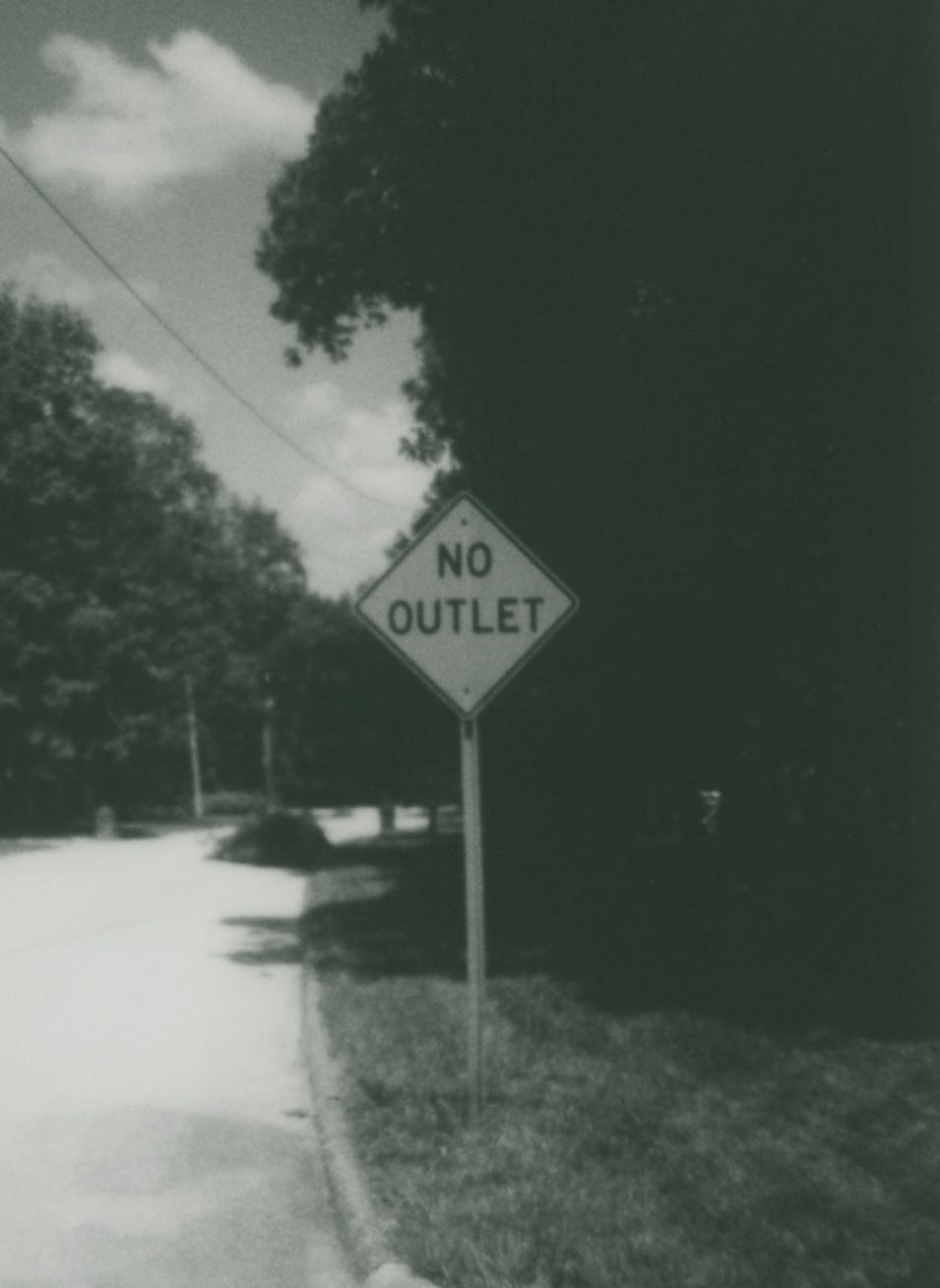
Home has eluded me most of my life. I’ve moved from town to town, never quite sure of where I’m from. In many ways, home has become an idea of a place, rather than a place. With so many fields out there, how do we ever choose? Can we?
Perhaps one day, in all our wanderings, we slip past the warning sign and find ourselves smack-dab in the middle of a cul-de-sac with no outlet. And after staying long enough, it becomes a little harder to imagine leaving. Maybe one day we’ve settled down enough to realize this field is just as good as any other. So we stop looking for another—and start living in ours. We begin to see that this field, with all its apparent shortcomings, has a certain depth and meaning far beyond its measurables. There’s a lifetime’s experience right here, now, in this field.
So, where are you from?
Maybe where we’re from is actually where we are, maybe it’s just as good as anywhere else, and maybe it needs no outlet to find.