
Middle Creek
Part One

Middle Creek is the name of the street where I live, named after the creek it follows. Neighbors hem us in on all sides, so that any memory of the creek might disappear entirely, were it not for those days following heavy rains, when the sound of rushing water seems to call out to us.
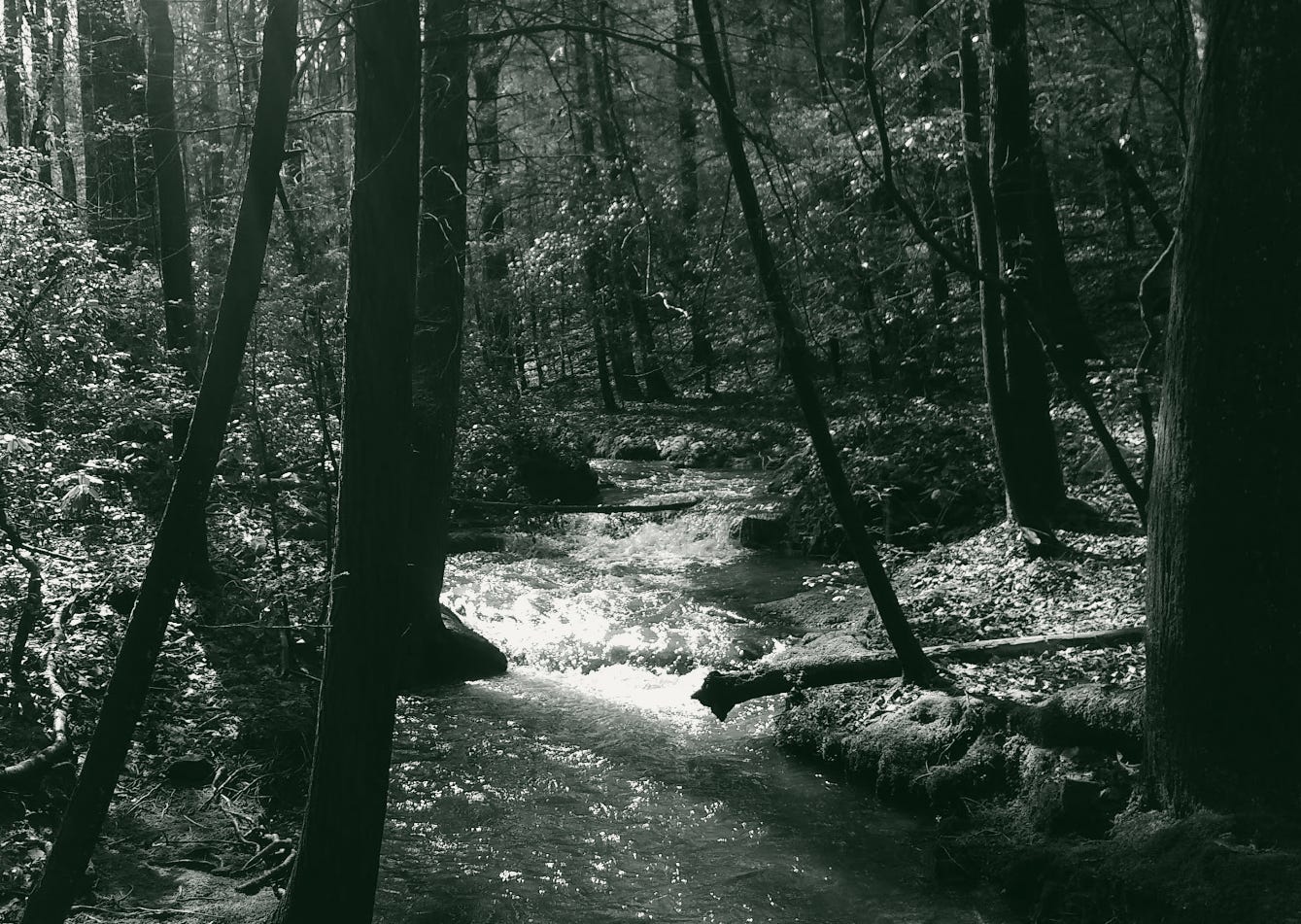
It’s a simple place to live, the kind of place slow enough to notice little things.
In the evenings, I walk with my family along Middle Creek and measure our pace against the feeder streams that cross our path on their way to the creek. We’ve named each stream after our three children in order of age—Thom Creek, Margot Creek, Waverly Creek—each child a little older, each creek a little further from home. At each one, we stop and reflect before we pass. We call it by its name and observe its measurables. Full of water or empty? Have the rocks along its foundation shifted? Have any creatures taken refuge along the banks? After heavy rains, we drop leaves and small branches upstream and race across the road to find them again, as if to ensure nothing is blocking the flow.
One thing is for certain—each time we pass, the creeks are never the same.
Each time we reflect, we see a change, some shift in the stones or subtle adjustment to the flow. Sometimes our leaves don’t make it through to the other side, and we search for whatever might be blocking the flow. Other times, the creeks are bone dry, no water at all.
Whatever gives life to the creeks has its origin outside of us. As the storms come and go, the creeks rise and fall, and we do the only thing we can—we keep watching, observing, searching for subtle shifts in its composition. We admire any changes we see, acknowledge how the creek has grown, plead for rains to fill it up. We search for whatever might restrain the flow.
The creek will flow long after the task of observation has passed along to someone else—but while it belongs to us, we will continue to call it by its name, notice it, and give it time to speak.